AI Model Release Digest — November 11, 2026
Six AI models shipped on November 11, 2026: Alibaba's Qwen4-Max preview, Baidu's ERNIE 5.5 Flash Preview, Google's Gemini 4 Carbon going generally available, DeepMind's Gemini Robotics 2.5, MiniMax H3-Image open weights, and AGIBOT's RoboBeats decision models. Each entry covers who released it, when, what it is, and what it can do.
Published November 11, 2026
Date: November 11, 2026 (Wednesday)
Scope: models officially released, launched, or open-weighted between 00:00 and 24:00 Beijing Time (UTC+8) on November 11, 2026. Duplicate coverage of the same model has been merged. Six entries.
1. Qwen4-Max (Preview)
Developer: Alibaba · Qwen Team
Release time: November 11, 2026
One-line summary: The flagship preview of the new-generation Qwen4 family, debuting on the Qwen AI platform's Token Plan and focused on coding and agentic capability in real-world tasks.
Key capabilities:
- Substantially upgraded coding and agentic (agent task execution) ability, aimed at complex programming, front-end design, professional office work, and operating professional software;
- Stronger world knowledge and perception; in internal testing it showed notable results in 3D modeling, web design, and interaction;
- Integrated into Qwen Office, Qoder, the Qwen app, and QwenStudio at launch; Token Plan users get a limited-time 80% discount, with new users receiving a further 50% off (as low as 90% off in total).
Official image:

2. ERNIE 5.5 Flash Preview
Developer: Baidu
Release time: November 11, 2026 (afternoon)
One-line summary: Baidu's latest foundation model, with 280B total parameters and 14B activated per token, supporting a 1M-token context and standing out in coding, 3D modeling, knowledge work, and content creation.
Key capabilities:
- Markedly stronger planning, execution, and iterative refinement on long-horizon development tasks, with dedicated training for game development;
- Targeted training on Blender, CAD, and similar tools delivers a clear jump in 3D modeling and spatial reasoning;
- For knowledge work in finance, law, and other domains, trained on 300,000 workspaces and 10 million reference files; video creation covers more than 150,000 creative environments;
- API already live on Baidu AI Cloud's Qianfan platform (RMB 2 per million input tokens at peak / 1 off-peak; RMB 8 per million output tokens at peak / 4 off-peak; limited-time 50% off), with weights to be open-sourced before November 25.
Official image:
3. Gemini 4 Carbon (Generally Available)
Developer: Google DeepMind
Release time: Early morning of November 11, 2026 Beijing Time (announced November 10 US Eastern)
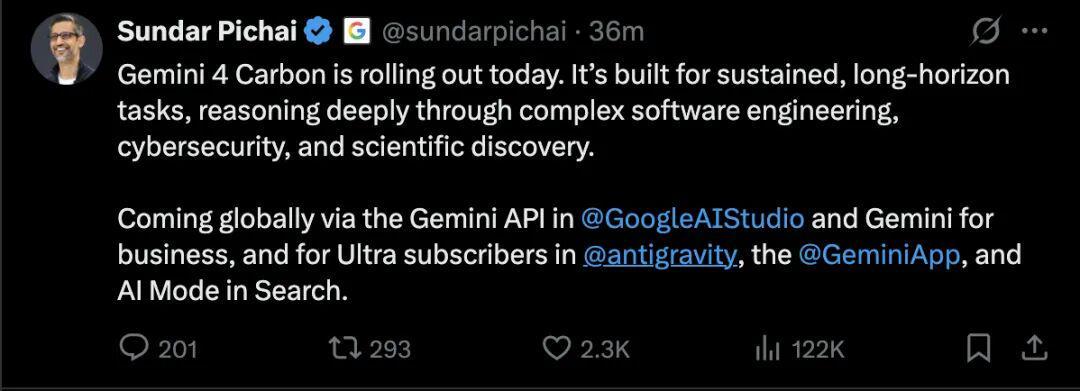
One-line summary: Google's most capable flagship model opened up broadly just two weeks after its debut, moving out of restricted testing with security teams to developers, enterprises, and Ultra subscribers.
Key capabilities:
- Ranked first on all three real-world workflow benchmarks — CursorBench 4.0, Perplexity WANDR, and Zapier AutomationBench — and scored 65.2% on Terminal-Bench 4.0;
- Built for long-horizon, complex work: multi-step coding, open-ended scientific research, and cybersecurity, at more than 2x lower cost per completed task than the next-best external model;
- A "/swarm" multi-agent feature previewed in Antigravity lets a single prompt orchestrate a coordinated team of agents;
- API introductory pricing of $2 per million input tokens and $10 per million output tokens (doubling after the promotional period at the end of November), available via Google AI Studio, Gemini for business, the Gemini app, and AI Mode in Search.
Official image (announcement post from Google CEO Sundar Pichai):
4. Gemini Robotics 2.5
Developer: Google DeepMind
Release time: November 11, 2026 Beijing Time (released November 10 US Eastern)
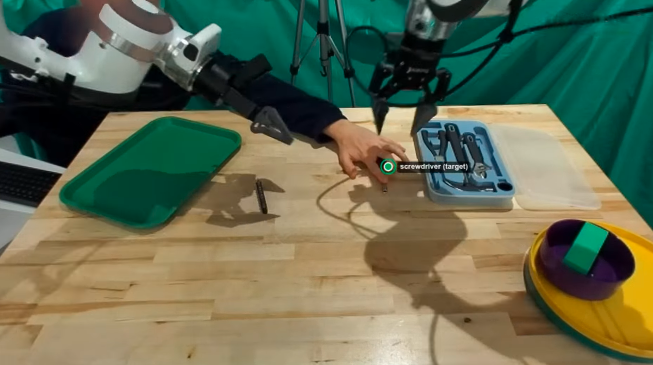
One-line summary: Google's most capable vision-language-action (VLA) robotics model to date, now available to Google's robotics partners.
Key capabilities:
- Across 200+ real-world task evaluations, task success rates improved by up to 100% over the prior baseline (e.g., pastry pickup from 5% to 100%, untying a ribbon bow from 0% to 70%), with execution up to 20%–30% faster;
- With Apptronik and Mercedes-Benz, the Apollo 2 humanoid completed parts kitting on live production lines in Hungary and Germany with a 96% success rate;
- R&D was accelerated by a simulation engine built on Gemini 4 Argon, making it the first foundation model sped up by Argon;
- Released alongside the open-source ASIMOV-Jailbreak safety benchmark, containing hundreds of disguised prompts to test jailbreak attacks against robots.
Official image:
5. MiniMax H3-Image
Developer: MiniMax (00100.HK)
Release time: Early hours of November 11, 2026 (official announcement published late on November 10)
One-line summary: An open-weight image generation model that produces a 4096×4096 (about 16MP) 4K image in under 10 seconds, up to 5x faster than mainstream alternatives.
Key capabilities:
- Supports text-to-image, reference-based generation, and image editing, with up to 16 reference images and what the company calls the strongest prompt adherence among open-weight models;
- Built on a 33.1B-parameter dense diffusion Transformer (DiT, 50 layers), reusing the Qwen3-VL text encoder, with sampling compressed to a fixed 6 steps and CFG removed;
- A companion 27B prompt-expansion model, H3-Image-PE, is open-sourced alongside it; weights are available on Hugging Face and ModelScope;
- Also available via the API platform, MiniMax Code, and Hailuo AI, priced at 50%–70% of comparable mainstream offerings, with 50% off 4K-and-above requests during launch week (note: the community license excludes the EU, UK, South Korea, and the US).
Official image:

6. RoboBeats (AGIBOT LIFE Lifelong Embodied Intelligence Framework)
Developer: AGIBOT (Zhiyuan Robotics)
Release time: November 11, 2026
One-line summary: AGIBOT released LIFE (Learning to Live), a lifelong embodied intelligence framework, open-sourcing the weights, code, and evaluation resources for its core lightweight decision models, RoboBeats (0.8B/2B/4B).
Key capabilities:
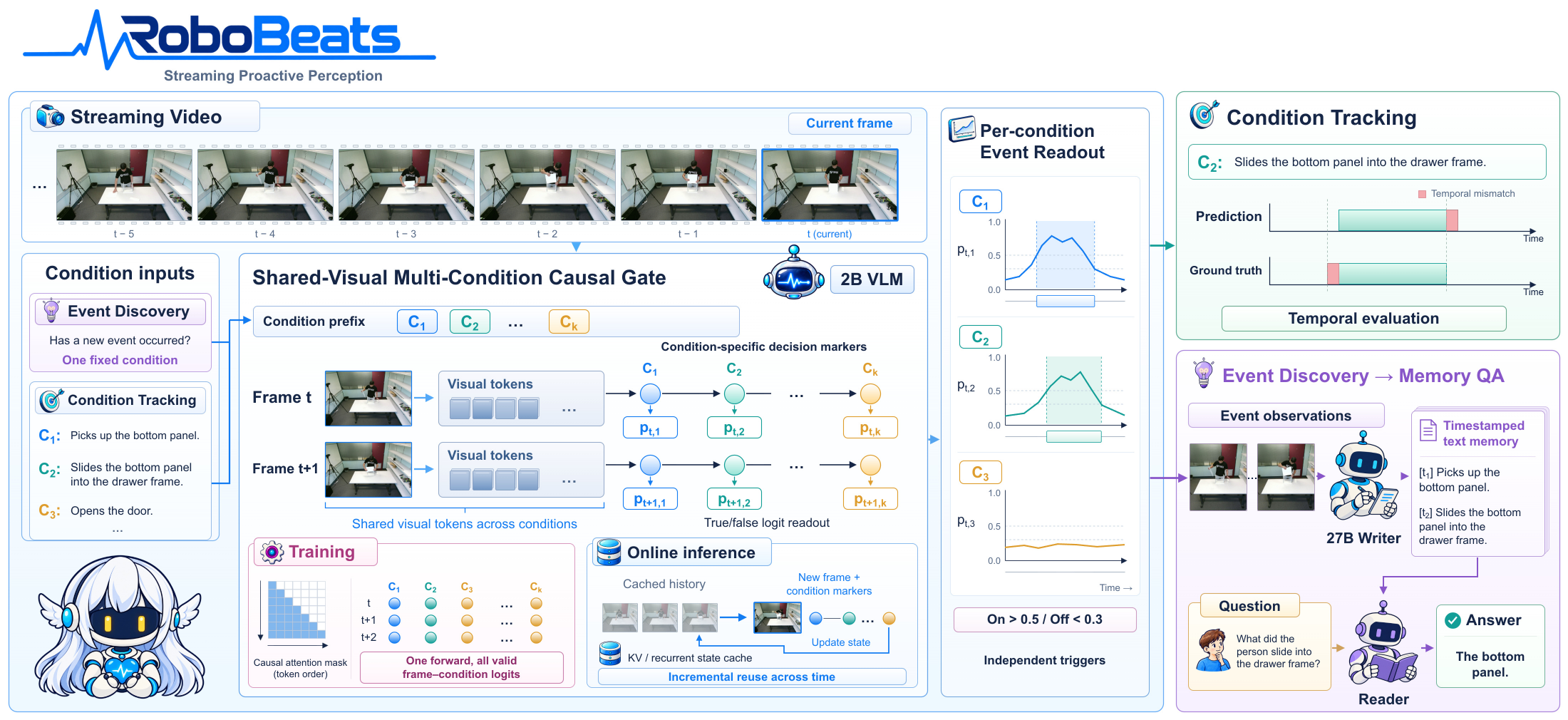
- RoboBeats handles streaming proactive perception — condition tracking and event discovery — reading true/false logits rather than generating frame-by-frame text;
- RoboBeats-4B raised StreamingBench proactive-output accuracy from 21.2% to 64.0% and SSS-Bench QA accuracy from 40.9% to 60.5%; RoboBeats-2B runs at roughly 75ms per frame on a single RTX 5090;
- LIFE combines RoboBeats, a PlasticMemory module, and EDM capability reuse; on 24 hours of real robot footage it scored 29.5/30 on memory question answering;
- Paper, project page, model weights, and SSS-Bench are all open at https://agibotgeneral.github.io/life-site
Official image (RoboBeats diagram from the official project page):